Our Learning
Religion and World Views
INTENT – to what do we aspire for our children?
In Religion and Worldviews (RW)), pupils enter into a rich discourse about the religious and non-religious traditions that have shaped Great Britain and the world. RW enables pupils to take their place within a diverse multi-religious and multi-secular society. At its best, it is intellectually challenging and personally enriching. It affords pupils both the opportunity to see the religion and non-religion in the world, and the opportunity to make sense of their own place in that world.
Source: Ofsted 2021
Although there is no National Curriculum statutory guidance for Religious and Worldviews, we follow the Non-Statutory Guidance published by the DfE in 2010.
At St Werburgh’s, we work together towards excellence, underpinned by the following values:
Kindness
● Our curriculum is broad, diverse and inclusive and celebrates religions from all around the world
● We develop respect and positive attitudes towards others and their beliefs, encouraging discussion whilst being respectful and tolerant
● We are collaborative by working together, sharing and using each others’ ideas and our own
● We teach children to use well-chosen language and demonstrate and model this in our own teaching in order to celebrate diversity positively.
Curiosity
● We ask ‘big questions’ that develop critical thinking, increasing children’s inspiration to learn and enhancing their understanding of other people and their beliefs
● We develop skills to evaluate and explore beliefs, encouraging children to explore ideas about faith and religion
● We engage in enrichment opportunities to see others’ beliefs and worship in practice
Commitment
● We proactively celebrate heritage and personal differences.
● We persevere to understand concepts and use that knowledge to help us explore philosophical questions
● We approach RW learning with resilience and an open-mind
● We work hard to develop and be able to articulate a secure foundational subject knowledge about different beliefs
British Values
At St Werburgh’s Primary School, we promote fundamental ‘British values’ through our school values and ethos, the curriculum, our rules and through our work as a UNICEF Rights Respecting School.
The value perhaps most relevant to Religious and Worldviews is that of mutual respect and tolerance.
Mutual Respect and Tolerance
UNCRC
Article 2 Every child has the right to be treated equally and with respect
Article 29 Every child has the right to an education
Article 14 Every child has the right to practice their own religion
Article 30 Every child has the right to practice their own culture
We actively teach respect and the valuing and celebration of difference from the moment children start with us in Reception. This is through our curriculum, the way we teach and manage behaviour and the way that we all interact with each other. We value kindness and do all we can to promote this. When things go wrong we encourage reflection and resolution with empathy. We learn about and make links between all major world religions through our curriculum, assemblies and class discussions. We pride ourselves on the importance we place on being proud of one’s heritage and the value of feeling a sense of belonging as part of our school community, ‘together towards excellence’.
Religion and Worldviews are key in engendering knowledge and understanding which can lead to tolerance and respect for others and their beliefs. Our RW curriculum contributes significantly to the British Values agenda, as it encourages evaluation and critical thinking, and equips children to consider belief positions they encounter.
Rights Respecting School
“UNICEF works with schools in the UK to create safe and inspiring places to learn, where children are respected, their talents are nurtured and they are able to thrive.” (UNICEF).
At St Werburgh’s, our work toward achieving the Rights Respecting Silver Schools Award embeds these values in our teaching and our learning. We use the UN Convention on the Rights of the Child (UNCRC) throughout our curriculum and School Vision.
Each of the articles in the UNCRC was written with the intention that they are accessed without hurting or discriminating against others. Through teaching our children that they have the right to follow a religion, but this should never hurt others’ feelings, we are able to instil harmony among the diverse range of beliefs and worldviews we are lucky to have at our school.
The curriculum for RW aims to ensure that all pupils:
- Develop as deep thinkers who are open-minded about religion and worldviews.
- Reflect on and prepare for life in modern Britain.
- Develop a deep understanding of concepts in order to be able to make connections, ask and respond to challenging questions
- Respect and appreciate worldviews that are different to their own
Curriculum Overview:
Long term sequence
Children will build their conceptual knowledge through studying religions and worldviews locally, nationally and globally in our progressive curriculum, enabling them to make links and connections between worldviews, develop disciplinary skills and build on their understanding of their positionality in relation to their learning . By revisiting key ‘big questions’ and building on prior knowledge, pupils will learn about how religion and worldviews are lived experiences across the world, consider the impact of worldviews on society and have opportunities to consider their personal worldviews.
Pupils will also meet this in other aspects of the provision, for example when celebrating key customs, traditions and events as a school, in assemblies, productions and when special visitors come in. Members of the community are actively encouraged to spend time with pupils sharing their experiences, expertise and aspirations. Care should be taken to ensure all religions and cultures are celebrated at some point throughout the year linked to the families in our school

Concept Mapping:
The core concepts that are sequenced and build on each other throughout the curriculum are:
Beliefs
Practices
Wisdom and Morality
Community and Belonging
These are referenced in the progression of skills and knowledge.
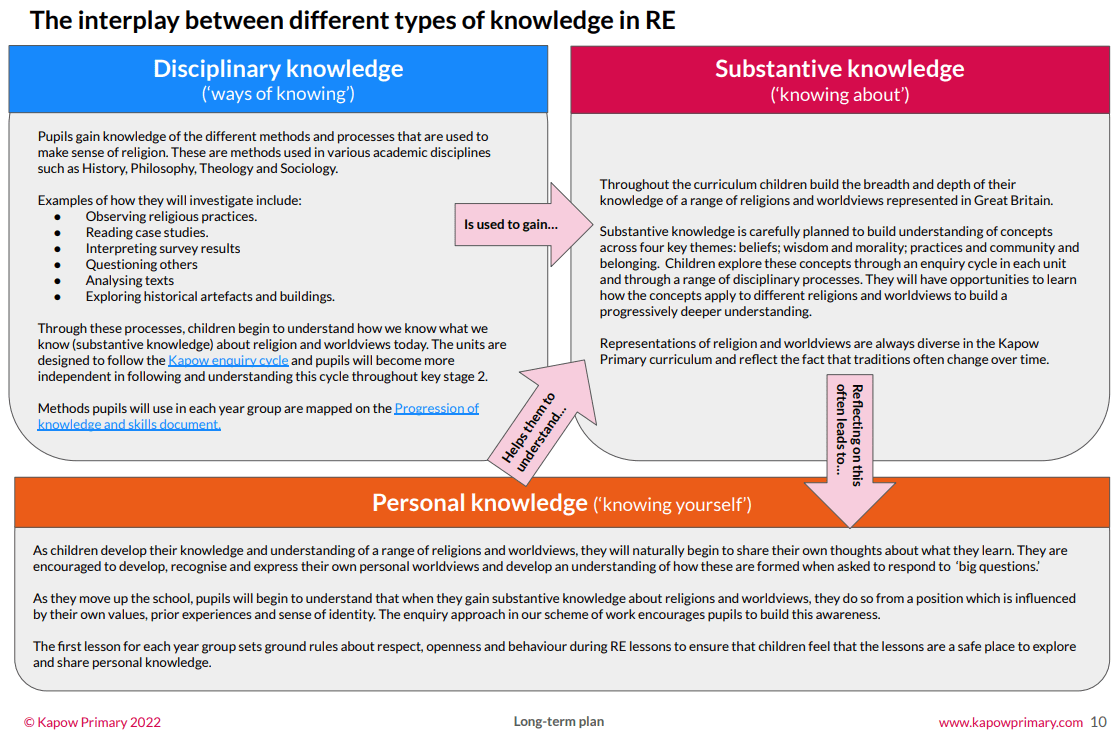
Substantive Knowledge:
Substantive knowledge is sequenced and builds on the knowledge that has gone before. An example below:


Disciplinary Skills Progression

EYFS
In EYFS children are taught about Religion and Worldviews following the Birth to 5 Matters. RW in the EYFS can contribute to most of the seven areas of learning that the framework outlines. It is most significant in these two areas: personal, social and emotional development, specifically ‘self confidence and self-awareness’, and understanding the world, specifically ‘people and communities’ and ‘the world’.
EYFS Early Learning Goals
- Talk about their immediate family and community and some of their routines, culture and celebrations.
- Recognise that people have different beliefs and celebrate special times in different ways.
- Understand that some places are special to members of their community.
- Name people who help others in the community and talk about their different roles.
- Know about similarities and differences between themselves and others, and among families, communities, cultures and traditions.
Oracy
We recognise the vital role that oracy plays in the lives and life chances of our children, therefore we plan explicit opportunities to develop their oracy skills as well as opportunities to learn through oracy across the curriculum.
We promote oracy through RE & Worldviews by teaching Tier 2 & 3 vocabulary which in turn allows the children to explain, discuss, debate and share their ideas when thinking about their reading more effectively.
IMPLEMENTATION – how will we deliver the curriculum?
Delivery of the Curriculum at St Werburgh’s
RW is taught weekly using the Kapow framework. The curriculum enables pupils to study in depth about key religions and vocabulary and demonstrate their understanding. Each unit builds upon prior learning and these are strategically planned throughout the academic year with opportunities to introduce and revisit key knowledge in order to deepen pupil understanding and embed learning.
Children will learn about the following different Religions and worldviews: Christianity, Judaism, Hinduism, Sikhism, Islam, Humanism and Buddhism.
Lesson Design

Each lesson follows the model above:
CONNECT to prior knowledge
EXPLAIN new content
Give an EXAMPLE of new learning
Pupils ATTEMPT new learning with scaffolding
APPLY new learning independently
Pupils are CHALLENGED to integrate learning with prior knowledge
The Kapow curriculum is designed to develop children’s enquiry skills. Each unit begins with a question, and over the course of the lessons children develop their response.

Knowledge Organisers are used for every unit.

Summary of the main reasons for use below:
Conveys the core knowledge in one place
A reference point for pupils and teachers
Used to support questioning and retrieval
Used in books to support participation
Highlights key vocabulary
Reduces split attention effect
SEND
The curriculum at St Werburgh’s Primary is inherently designed to support pupils with SEND through universal quality first teaching. This includes:
- High expectations and aspirations for all learners
- A carefully structured and sequenced curriculum, specifically designed around how pupils learn
- Pre-planned and focused direct vocabulary instruction
- Modelling and demonstration
- Chunked instructions which are supported by visuals and gestures
- The use of multi-sensory approaches to enhance the curriculum
- Frequent formative assessment as teachers check for understanding
- Accurate and regular feedback
However, we recognise some children need provision ‘additional to’ quality first teaching in order to reach their potential. This includes:
- Carefully considered scaffolding
- Explicit instruction and modelling
- Structured challenge, without ceilings
- Alternative ways of recording
- Additional targeted adult support
In some instances, specialist adaptations are made to support the specific barriers of individual pupils.
Reading across the curriculum
There are topic specific texts to support the children’s learning alongside additional reading in the school bus.


Curriculum enrichment at St Werburgh’s
During these units, teachers will always look for opportunities to invite parents or visitors into their classes to further enrich the curriculum and to present information about their faith. Where relevant, teachers also encourage children or staff members in their class to share their own experiences of their faith with their peers.
- Assemblies/collective worship and specialist visitors
- Extra-curricular activities
- Philosophical/critical thinking questions
- Passport of experiences links to visiting local places of worship
IMPACT – how do we know our curriculum is effective?
The Kapow curriculum is designed to ensure sequencing of core knowledge, vocabulary, substantive concepts and disciplinary knowledge. They will know more, and remember more with the taught curriculum content. Essentially they will be able to do more with this knowledge in carefully designed learning tasks.
Formative assessment
Strategies that might be used are:
- Making explicit the learning intention and success criteria
- Eliciting evidence of pupils’ prior knowledge
- Feeding back at the point of learning
- Inclusive questioning i.e. cold call, mini whiteboards
- Retrieval practice i.e. cumulative quizzing
Pupil Voice
- Use correct terminology and specific vocabulary that has been covered in the learning
- Talk about the meaning of the learning and the impact on themselves and those around them
- Talk about the ‘why’ of the RW learning
- Children are able to ask questions confidently and explore their own and each other’s responses
- Children demonstrate how learning builds on previous knowledge
High quality outcomes:
We will monitor our curriculum through floor books and discussions with pupils.
These will:
- Demonstrate pride and effort.
- Capture increasing understanding of RW specific concepts and knowledge.
- Demonstrate a clear sequence of learning.
- Include vocabulary that is clearly seen and used correctly.
- Demonstrate that learners make progress regardless of starting points
Parents have the right to withdraw children from Religion and Worldview lessons.